How to program PLC to drive
HLP2B、HLP2C
and HLP2D
digital panel meter
1. Data buildup
HLP2 PLC digital meter can display data from PLC, the relation list below:
|
HLP2□-□□ digital meter displays |
The data sand to PLC
register |
Remark |
|
0 |
0 |
Display corresponding
Digit |
|
1 |
1 |
|
|
2 |
2 |
|
|
3 |
3 |
|
|
4 |
4 |
|
|
5 |
5 |
|
|
6 |
6 |
|
|
7 |
7 |
|
|
8 |
8 |
|
|
9 |
9 |
|
|
|
A |
Also
can design corresponding
letter or symbol for customer,for
example AbcdEF etc. |
|
|
B |
|
|
|
C |
|
|
|
D |
|
|
"display nothing" |
E |
|
|
F |
F |
HLP2C、HLP2D digital panelmeters have two and a half bytes(20 bits), the last 16 of which is the data need to display. The first four bits of HLP2C are extensive output bits; the first two bits of ;HLP2D meter is to ensure the position of the decimal, while the third and fourth bits are extensive output bits. The data struction is well-presented in the following graph.
How to use the extensive bits of HLP2C,D: since the extensive output is data signal from the double-wire serial interface of PLC, it may be influenced by some factors and to lower the transmission speed. We recommend it use in the non-control field, such as indicator lamp; if it must be used in control field, it can be used in the insignificant situation with low speed.
2. Programming skills of PLC digital panel mters
Take OMRON PLC as an example to illustrate the
method, other PLC can refer to this method.
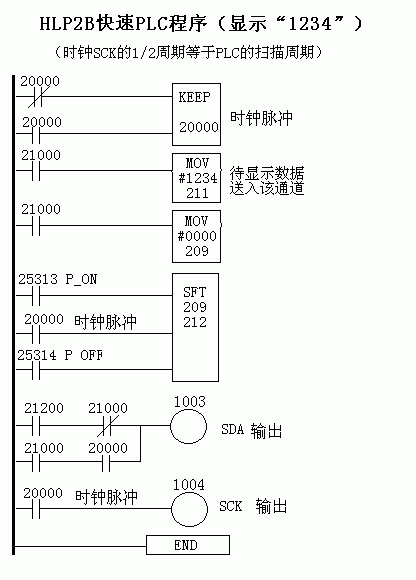
there are five parts in the process of the programming.
1: generate clock pulse. "KEEP" is used to generate pulse according to
the period of scanning in OMRON. Some PLC do not need such process, while they
use the particular clock pulse generated by PLC.
2:send the data which need displaying to the data buffer and reset the control
buffer. For example "MOV #1234" sends constant #1234 to the buffer
211. If you want to display a variable, you can send a particular buffer to
buffer 211, and send the data to the particular buffer will make it.
3: "SFT" can move the data in four buffers from 209 to 212 one bit
left and fill the vacancy at right wiht "1". It doesnot need
resetting.
4: "SDA" is data output which satisfies the output of "Sink"
transistor, when it comes to the "source" transistor, it needs to
revert.
5: "SCK" is the output of clock pulse which satisfies the
"Sink" transistor, when it comes to the "source" transistor,
it needs to revert.
Only process 3 is needed to repeat to deal with the situation of bi-watch or
multi-watch.